
Nixon's piano
presidents and racial politics from Washington to Clinton
Our rough guess is there are 131,250 words in this book.
At a pace averaging 250 words per minute, this book will take 8 hours and 45 minutes to read. With a half hour per day, this will take 18 days to read.
How long will it take you?
This book will take an estimated to read at a reading speed averaging words per minute. With 30 minutes per day, this will take to read.
Enter your reading speedYou can take one of our WPM reading speed tests to find your reading speed.
Create a free account to track your reading progress, build your reading list, and set reading goals.
We earn a commission on purchases
Word Count
131,250 words, Guess
Page Count
525 pages
Identifiers
- Open LibraryOL791566M
- ISBN-100029236851
- OCLC Control Number32746938
- OCLC Control Numbernixonspianopresi00orei
- Library of Congress Control Number95024095
and 2 more
- LibraryThing955801
- Goodreads403661
Classifications
- DDC306.2/4
- LCCE176.1 .O74 1995
Description
Kenneth O'Reilly, whose Racial Matters blew the lid off the FBI's investigation and harassment of black leaders, now scrutinizes each president's record on race. Nixon's Piano reveals that instead of being the agents of progress in racial relations, American presidents have a long and consistent history of supporting slavery, obstructing civil rights, and deliberately fanning racism. With the exceptions of Abraham Lincoln and Lyndon Johnson, argues O'Reilly, every president has sacrificed black rights for white votes. Perhaps most alarming, O'Reilly offers substantial evidence of presidents whose repressive political policies violated their own moral code. George Washington corresponded with Lafayette about the evils of slavery and mused about establishing a plantation for freed blacks, but President Washington kept his slaves and refused to lend the weight of his office to the abolitionist movement. Jefferson, certain and eloquent on the subject of equality in the Declaration of Independence, found no voice as president to oppose slavery. Lincoln, the first president to allow blacks at White House social functions and the eventual hero of the abolitionist movement, opposed black efforts to vote, sit on juries, hold office, or marry whites. Like many other presidents, Lincoln supported the colonization movement as the simplest solution to the nation's racial strife. FDR, the father of twentieth century social reform, but fearful of offending white voters, refused to support an anti-lynching law, banned black reporters from press conferences, and undermined his own Fair Employment Practice Committee. More recent presidents, according to O'Reilly, have pursued a racial politics ranging from the timid to the devious. With substantial evidence and insightful analysis of both official policy and private conduct, O'Reilly illustrates that the principle of white over black has been the fundamental organizing principle of American politics from the beginning of our nation's history to today.
Subjects
Topics
Places
Similar Books
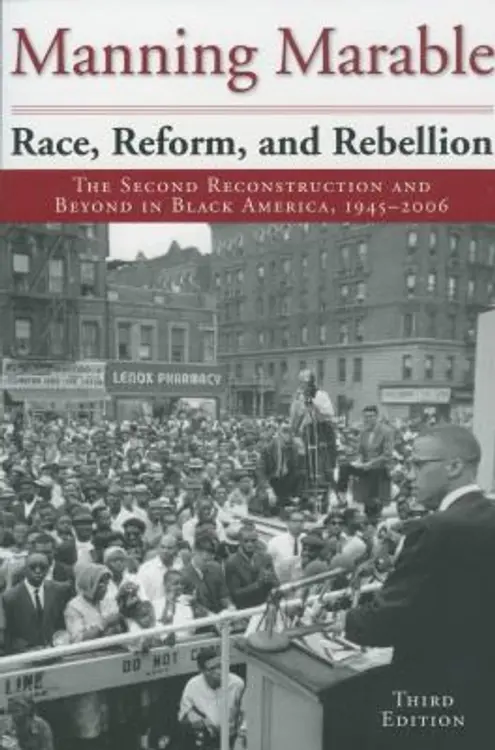
Race, Reform, and Rebellion: The Second Reconstruction and Beyond in Black America, 1945-2006, Third Edition
Manning Marable, Manning Marable

Where do we go from here: chaos or community?
Martin Luther King, Jr. ; [foreword by Coretta Scott King ; introduction by Vincent Harding]

Notes of a native son
James Baldwin ; with a new introduction by Edward P. Jones

Malcolm X speaks: selected speeches and statements
edited with prefatory notes by George Breitman.
Reader Reviews
No reviews yet for this book.
Be the first to share your thoughts!