
Moral fiction in Milton and Spenser
Our rough guess is there are 50,000 words in this book.
At a pace averaging 250 words per minute, this book will take 3 hours and 20 minutes to read. With a half hour per day, this will take 7 days to read.
How long will it take you?
This book will take an estimated to read at a reading speed averaging words per minute. With 30 minutes per day, this will take to read.
Enter your reading speedYou can take one of our WPM reading speed tests to find your reading speed.
Create a free account to track your reading progress, build your reading list, and set reading goals.
We earn a commission on purchases
Author
Publication
1995 - University of Missouri Press, Columbia, Missouri
Language
English
Word Count
50,000 words, Guess
Page Count
200 pages
Identifiers
- Open LibraryOL780923M
- ISBN-100826210171
- OCLC Control Number32469691
- OCLC Control Numbermoralfictioninmi00stea
- Library of Congress Control Number95012810
and 1 more
- Goodreads596243
Classifications
- DDC821/.309
- LCCPR3592.E8 S84 1995
Description
In Moral Fiction in Milton and Spenser, John M. Steadman examines how Milton and Spenser - and Renaissance poets in general - applied their art toward the depiction of moral and historical "truth." Steadman centers his study on the various poetic techniques of illusion that these poets employed in their effort to bridge the gap between truth and imaginative fiction. Emphasizing the significant affinities and the crucial differences between the seventeenth-century heroic poet and his sixteenth-century "original," Steadman analyzes the diverse ways in which Milton and Spenser exploited traditional invocation formulas and the commonplaces of the poet's divine imagination. Steadman suggests that these poets, along with most other Renaissance poets, did not actually regard themselves as divinely inspired but, rather, resorted to a common fiction to create the appearance of having special insight into the truth. The first section of this study traces the persona of the inspired poet in DuBartas's La Sepmaine and in The Faerie Queene and Paradise Lost. Reevaluating the views of twentieth-century critics, it emphasizes the priority of conscious fiction over autobiographical "fact" in these poets' adaptations of this topos. The second section develops the contrast between the two principal heroic poems of the English Renaissance, The Faerie Queene and Paradise Lost, in terms of the contrasting aesthetic principles underlying the romance genre and the neoclassical epic.
Subjects
Topics
Similar Books

The faerie queene
Edmund Spenser ; edited by Thomas P. Roche, Jr., with the assistance of C. Patrick O'Donnell, Jr.
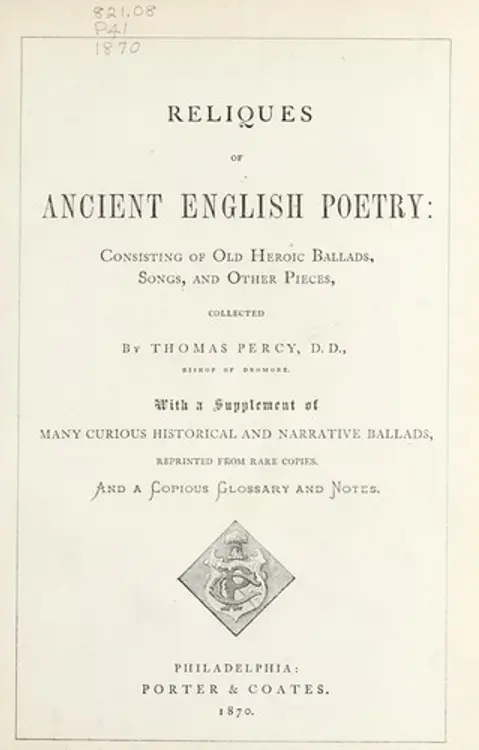
Reliques of ancient English poetry: consisting of old heroic ballads, songs, and other pieces ... with a supplement of many curious historical and narrative ballads, reprinted from rare copies, and a copious glossary and notes
Henry Benjamin Wheatley, Thomas Percy

Poems
With an introd. by Arthur Waugh

John Donne's Poetry
John Booty, P.G. Stanwood, John Donne

Paradise lost
John Milton ; edited with an introduction and notes by John Leonard.
5h 41m readMilton's ode on the morning of Christ's nativity: L'allegro ; Il penseroso ; and Lycidas
[edited] by A.W. Verity.
Reader Reviews
No reviews yet for this book.
Be the first to share your thoughts!