
The Mechanical universe-- and beyond
Part I, The mechanical universe, programs 1-4
Our rough guess is there are 30,000 words in this book.
At a pace averaging 250 words per minute, this book will take 2 hours and 0 minutes to read. With a half hour per day, this will take 4 days to read.
How long will it take you?
This book will take an estimated to read at a reading speed averaging words per minute. With 30 minutes per day, this will take to read.
Enter your reading speedYou can take one of our WPM reading speed tests to find your reading speed.
Create a free account to track your reading progress, build your reading list, and set reading goals.
Author
Contributions
- California Institute of Technology - Contributor
- Southern California Consortium for Community College Television - Contributor
Publication
2003 - Annenberg/CPB, S. Burlington, VT, Vermont
Language
English
Word Count
30,000 words, Guess
Page Count
120 pages
Physical Format
Video Recording
Identifiers
- OCLC Control Number54833132
- Open LibraryOL47075683M
Alternate Titles
- Mechanical universe (Television program)
- Law of falling bodies.
- Derivatives.
- Inertia.
Description
Program 27 looks at electricity, magnetism, and the twentieth century discoveries of relativity and quantum mechanics. Program 28 looks at Coulomb's law and the principles of static electricity. Program 29 deals with Michael Faraday's contribution to the modern idea of the field of force. Also covers electric fields of static charges, Gauss's law, and the conservation of flux. Program 30 discusses Benjamin Franklin's theory of the Leyden jar and his invention of the parallel plate capacitor. Also covers electrical potential, the potential of charged conductors, equipotentials, and capacitance. Uses computer animation sequences, historical reenactments, and close-up photography of experiments.
Description
Program 1 introduces revolutionary ideas and heroes from Copernicus to Newton and links the physics of the heavens and the earth. Program 2 covers Galileo's experiments which proved that all bodies fall with the same constant acceleration. Program 3 deals with the function of mathematics in physical science and the derivative as a practical tool. Program 4 deals with Galileo's efforts to answer questions about the nature of universe, the development of his law of inertia, and the risks that he took in challenging accepted knowledge of the period. Uses computer animation sequences, historical reenactments, and close-up photography of experiments.
Subjects
Topics
People
Other Editions
- The Mechanical universe-- and beyond: Part I, The mechanical universe, programs 1-4
Show 5 more editions
Similar Books

Mysteries of the Universe: Stars
Jim Whiting
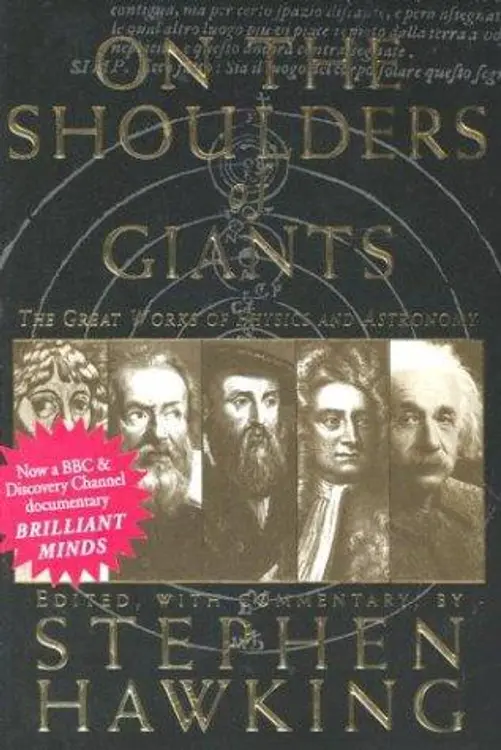
On the Shoulders of Giants: The Great Works of Physics and Astronomy
S. W. Hawking

Einstein, Hilbert, and the theory of gravitation: historical origins of general relativity theory
by Jagdish Mehra.
Relativity: the special and the general theory
Albert Einstein

Space, time and gravitation: an outline of the general relativity theory
by A.S. Eddington.
Joe-Joe the Wizard Brews up Solids, Liquids, and Gases
Robin Boyden, Terry Flaherty, Paul Ohmann, Eric Braun

Eyewitness: Russia (Eyewitness Books)
Dk Publishing

Whoosh!: Wile E. Coyote Experiments with Flight and Gravity
Alan Brown, Mark Weakland, Warner Bros., Paco Sordo
Reader Reviews
No reviews yet for this book.
Be the first to share your thoughts!