
Cities of God
The Real Story of How Christianity Became an Urban Movement and Conquered Rome
Our rough guess is there are 72,000 words in this book.
At a pace averaging 250 words per minute, this book will take 4 hours and 48 minutes to read. With a half hour per day, this will take 10 days to read.
How long will it take you?
This book will take an estimated to read at a reading speed averaging words per minute. With 30 minutes per day, this will take to read.
Enter your reading speedYou can take one of our WPM reading speed tests to find your reading speed.
Create a free account to track your reading progress, build your reading list, and set reading goals.
Word Count
72,000 words, Guess
Page Count
288 pages
Identifiers
- ISBN-139780061349881
- ISBN-100061349887
- LibraryThing1856361
- Goodreads1980657
- OCLC Control Number153579533
and 2 more
- Better World Books9780061349881
- Open LibraryOL7290031M
Classifications
- DDC270.1
- LCCBR162.3 .S73 2006
Description
How did the preaching of a peasant carpenter from Galilee spark a movement that would grow to include over two billion followers? Who listened to this "good news," and who ignored it? Where did Christianity spread, and how? Based on quantitative data and the latest scholarship, preeminent scholar and journalist Rodney Stark presents new and startling information about the rise of the early church, overturning many prevailing views of how Christianity grew through time to become the largest religion in the world.Drawing on both archaeological and historical evidence, Stark is able to provide hard statistical evidence on the religious life of the Roman Empire to discover the following facts that set conventional history on its head:Contrary to fictions such as The Da Vinci Code and the claims of some prominent scholars, Gnosticism was not a more sophisticated, more authentic form of Christianity, but really an unsuccessful effort to paganize Christianity.Paul was called the apostle to the Gentiles, but mostly he converted Jews.Paganism was not rapidly stamped out by state repression following the vision and conversion of the Roman Emperor Constantine in 312 AD, but gradually disappeared as people abandoned the temples in response to the superior appeal of Christianity.The "oriental" faiths—such as those devoted to Isis, the Egyptian goddess of love and magic, and to Cybele, the fertility goddess of Asia Minor—actually prepared the way for the rapid spread of Christianity across the Roman Empire.Contrary to generations of historians, the Roman mystery cult of Mithraism posed no challenge to Christianity to become the new faith of the empire— it allowed no female members and attracted only soldiers.By analyzing concrete data, Stark is able to challenge the conventional wisdom about early Christianity offering the clearest picture ever of how this religion grew from its humble beginnings into the faith of more than one-third of the earth's population.
Subjects
Other Editions
- Cities of God
Similar Books

The Early Church: Volume 1 (Hist of the Church)
Henry Chadwick

The lost history of Christianity: the thousand-year golden age of the church in the Middle East, Africa, and Asia- and how it died
Philip Jenkins.

From Paul to Valentinus: Christians at Rome in the first two centuries
Peter Lampe ; translated by Michael Steinhauser ; edited by Marshall D. Johnson.

The rise of Western Christendom: triumph and diversity, A.D. 200-1000
Peter Brown.
Eusebius' Ecclesiastical history: according to the text of Burton
with an introduction by William Bright.
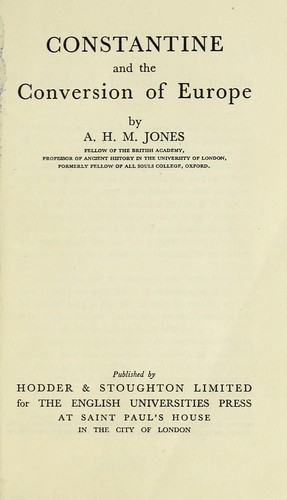
Constantine and the conversion of Europe.
A. H. M. Jones
Reader Reviews
No reviews yet for this book.
Be the first to share your thoughts!