
Holy Bishops in Late Antiquity
The Nature of Christian Leadership in an Age of Transition (Transformation of the Classical Heritage)
1 edition
Our rough guess is there are 89,500 words in this book.
At a pace averaging 250 words per minute, this book will take 5 hours and 58 minutes to read. With a half hour per day, this will take 12 days to read.
How long will it take you?
This book will take an estimated to read at a reading speed averaging words per minute. With 30 minutes per day, this will take to read.
Enter your reading speedYou can take one of our WPM reading speed tests to find your reading speed.
Create a free account to track your reading progress, build your reading list, and set reading goals.
Word Count
89,500 words, Guess
Page Count
358 pages
Physical Format
Hardcover
Identifiers
- Open LibraryOL7711956M
- ISBN-139780520242968
- ISBN-100520242963
- OCLC Control Number55665256
- OCLC Control Numberholybishopslatea00rapp_768
and 3 more
- Library of Congress Control Number2004013430
- Goodreads1260826
- LibraryThing941458
Classifications
- LCC2004013430
Description
Between 300 and 600, Christianity experienced a momentous change from persecuted cult to state religion. One of the consequences of this shift was the evolution of the role of the bishop--as the highest Church official in his city--from model Christian to model citizen. Claudia Rapp's exceptionally learned, innovative, and groundbreaking work traces this transition with a twofold aim: to deemphasize the reign of the emperor Constantine, which has traditionally been regarded as a watershed in the development of the Church as an institution, and to bring to the fore the continued importance of the religious underpinnings of the bishop's role as civic leader. Rapp rejects Max Weber's categories of "charismatic" versus "institutional" authority that have traditionally been used to distinguish the nature of episcopal authority from that of the ascetic and holy man. Instead she proposes a model of spiritual authority, ascetic authority and pragmatic authority, in which a bishop's visible asceticism is taken as evidence of his spiritual powers and at the same time provides the justification for his public role. In clear and graceful prose, Rapp provides a wholly fresh analysis of the changing dynamics of social mobility as played out in episcopal appointments.
First Sentence
The emperor, the holy man, and the bishop.
Subjects
Topics
Other Editions
- Holy Bishops in Late Antiquity: The Nature of Christian Leadership in an Age of Transition (Transformation of the Classical Heritage)
Similar Books

The rise of Western Christendom: triumph and diversity, A.D. 200-1000
Peter Brown.

A Voice in the Wind: Mark of the Lion #1 (Mark of the Lion)
Francine Rivers

Quo vadis: a narrative of the time of Nero
Henryk Sienkiewicz.
An echo in the darkness
Francine Rivers

Les Évangiles et la seconde génération chrétienne
par Ernest Renan ...

The Early Church: Volume 1 (Hist of the Church)
Henry Chadwick

From Paul to Valentinus: Christians at Rome in the first two centuries
Peter Lampe ; translated by Michael Steinhauser ; edited by Marshall D. Johnson.
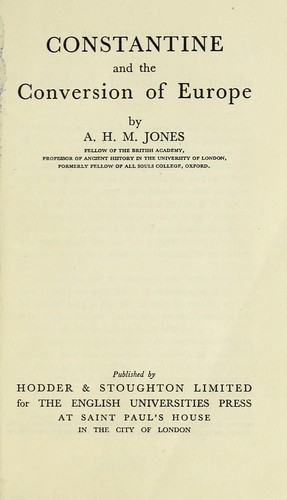
Constantine and the conversion of Europe.
A. H. M. Jones
Reader Reviews
No reviews yet for this book.
Be the first to share your thoughts!