
Ḳinah tseḥorah
shirim, 1992-2008
Our rough guess is there are 64,750 words in this book.
At a pace averaging 250 words per minute, this book will take 4 hours and 19 minutes to read. With a half hour per day, this will take 9 days to read.
How long will it take you?
This book will take an estimated to read at a reading speed averaging words per minute. With 30 minutes per day, this will take to read.
Enter your reading speedYou can take one of our WPM reading speed tests to find your reading speed.
Create a free account to track your reading progress, build your reading list, and set reading goals.
Word Count
64,750 words, Guess
Page Count
259 pages
Identifiers
- Open LibraryOL24016820M
- ISBN-139781565921979
- ISBN-101565921976
- OCLC Control Number1038426666
- OCLC Control Number467777509
and 4 more
- OCLC Control Number42854475
- OCLC Control Number35900423
- Internet Archivesecretoracleinle0000debe
- Library of Congress Control Number2009465489
Classifications
- LCCPJ5054.R3393 K56 2009
- LCCTX771 .W464 2009
- LCCQA76.73.P98 L88 1996
and 4 more
- LCCQA76.9.D3 D434 2008
- LCCQA76.73.P98L88 1996
- LCCJQ1825.S873 M84 2017
- LCCQA76.73.P98 L88 1996eb
Alternate Titles
- Lucid lamentation
Description
With Python, you can do almost anything you can do with the C or C++ programming languages; but Python is an interpreted language designed for rapid application development and deployment. Python is easy to read and write so that you can accomplish common tasks quickly, but it is also extensible when the complexity of the task requires additional power. Python programs can call C and C++ modules. Python can also be embedded in C and C++ programs. You can use Python with Tk as well, making it an ideal language for prototyping and deploying Graphical User Interfaces (GUI). Python is as easy, or as powerful, as you want it to be. Programming Python is a comprehensive companion to this scripting language. It introduces the language to novice users, but it also contains advanced information about embedding and extending Python for advanced users. The book moves quickly from simple to intermediate to complex tasks. Most of all, Programming Python is practical and full of examples you'll use, including shell tools, database access, rapid development tools, and Internet scripting.
Subjects
Topics
Similar Books

Learning Python
David Ascher, Mark Lutz

Introduction to Machine Learning with Python: A Guide for Data Scientists
Andreas C. Mueller, Sarah Guido

Python For Data Analysis
Wes McKinney

Programming Python
Mark Lutz

Fluent Python: Clear, Concise, and Effective Programming
by Luciano Ramalho

Data wrangling with Python
Jacqueline Kazil and Katharine Jarmul
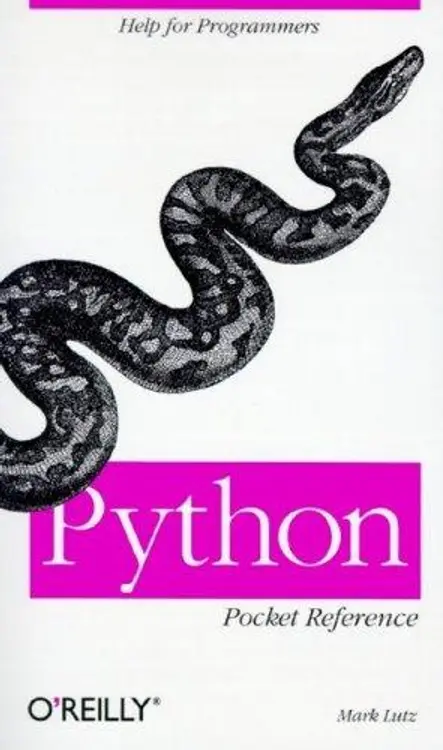
Python: Pocket Reference
Mark Lutz

Automate the Boring Stuff with Python: Practical Programming for Total Beginners
by Al Sweigart.
Reader Reviews
No reviews yet for this book.
Be the first to share your thoughts!