
The science of The Hitchhiker's Guide to the Galaxy
Our rough guess is there are 48,750 words in this book.
At a pace averaging 250 words per minute, this book will take 3 hours and 15 minutes to read. With a half hour per day, this will take 7 days to read.
How long will it take you?
This book will take an estimated to read at a reading speed averaging words per minute. With 30 minutes per day, this will take to read.
Enter your reading speedYou can take one of our WPM reading speed tests to find your reading speed.
Create a free account to track your reading progress, build your reading list, and set reading goals.
Author
Contributions
- Adams, Douglas, 1952- - Contributor
Publication
2005 - Macmillan, New York, New York (State)
Language
English
Word Count
48,750 words, Guess
Page Count
195 pages
Identifiers
- Open LibraryOL3422342M
- ISBN-139781403945778
- ISBN-101403945772
- OCLC Control Number58919804
- Internet Archivescienceofhitchhi00mich
and 3 more
- Library of Congress Control Number2005043893
- Goodreads670177
- LibraryThing116840
Classifications
- DDC823/.914
- LCCPR6051.D3352 H534 2005
Description
Ever wonder what the Universe might actually look like? Why the number 42 is so significant? Whether time travel really would put a stop to history as we know it? If you are so clearly a fan of Douglas Adams' The Hitchhikker's Guide to the Galaxy, now a major motion picture. Much of the book is sheer whimsy: talking mattress, the Vogons, triple-breasted whores, and that Ol' Janx Spirit. But like all good science fiction, it contains more than a grain of scientific fact. Adams was a science and technology enthusiast and his books were inspired by - prefigured even - many of the great scientific debates of our times. The Science of the Hitchhiker's Guide to the Galaxy is a light-hearted, accessible and informative tour of the real cutting-edge research behind the cornerstones of a cherished sci-fi classic - from the Big Bang to the end of the Universe via probability, supercomputing, time travel, instant translation, alien life, and more.
Description
"Ever wondered what the End Of The Universe might actually look like? Why the number 42 is so significant? Whether time travel really would put a stop to history as we know it? If so you are clearly a fan of Douglas Adams' The Hitchhiker's Guide to the Galaxy, now a major motion picture." "Much of the book is sheer whimsy: talking mattresses, the Vogons, triple-breasted whores and that Ol' Janx Spirit. But like all good science fiction, it contains more than a grain of scientific fact. Adams was a science and technology enthusiast and his books were inspired by - prefigured even - many of the great scientific debates of our times." "The Science of The Hitchhiker's Guide to the Galaxy is a light-hearted, accessible and informative tour of the real cutting-edge research behind the corner-stones of a cherished sci-fi classic - from the Big Bang to the end of the Universe via probability, supercomputing, time travel, instant translation, alien life and more."--BOOK JACKET.
Subjects
Topics
People
Other Editions
- The science of The Hitchhiker's Guide to the Galaxy
Similar Books

Mostly Harmless
Douglas Adams

The More Than Complete Hitchhiker's Guide
Douglas Adams

Don't Panic: Douglas Adams & The Hitchhiker's Guide to the Galaxy
Neil Gaiman.

The Hitchhiker's Guide to the Galaxy: A Trilogy in Four Parts
Douglas Adams
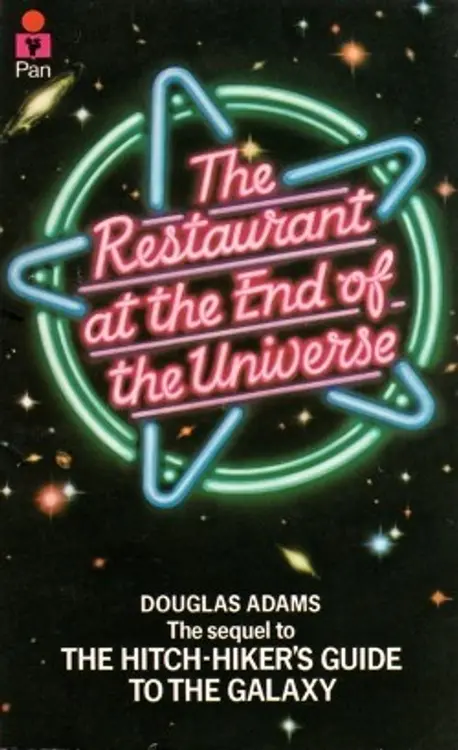
The Restaurant at the End of the Universe
Douglas Adams.

On nineteen eighty-four: Orwell and our future
edited by Abbott Gleason, Jack Goldsmith, and Martha C. Nussbaum.

The Road to Science Fiction: Volume 3: From Heinlein to Here (Road to Science Fiction (Scarecrow Press))
James E. Gunn, Ray Bradbury, Isaac Asimov
The early H. G. Wells: a study of the scientific romances.
Bergonzi, Bernard.
Reader Reviews
No reviews yet for this book.
Be the first to share your thoughts!