
The art of loving
female subjectivity and male discursive traditions in Shakespeare's tragedies
Our rough guess is there are 38,250 words in this book.
At a pace averaging 250 words per minute, this book will take 2 hours and 33 minutes to read. With a half hour per day, this will take 5 days to read.
How long will it take you?
This book will take an estimated to read at a reading speed averaging words per minute. With 30 minutes per day, this will take to read.
Enter your reading speedYou can take one of our WPM reading speed tests to find your reading speed.
Create a free account to track your reading progress, build your reading list, and set reading goals.
Author
Publication
1992 - Associated University Presses, Newark, Delaware
Language
English
Word Count
38,250 words, Guess
Page Count
153 pages
Identifiers
- Library of Congress Control Number90050430
- Better World Books9780874133981
- Open LibraryOL1888919M
- ISBN-10087413398X
- ISBN-139780874133981
and 1 more
- Goodreads499169
Classifications
- DDC822.3/3
- LCCPR2983 .G35 1991
- LCCPR2983.G35 1991
Description
To be a subject is to be able to speak, to give meaning. The Art of Loving interrogates the phenomenon of "theatrical subjectivity"--Female protagonists as both subjects and objects on the early modern English stage and within the illusion of Shakespeare's tragedies. The disparity between females as acting, speaking subjects onstage and male protagonists' objectifications of them constitutes the dominating gendered irony of the dramatic texts. In Romeo and Juliet, Othello, and Antony and Cleopatra, Professor Gajowski argues, women are not portrayed as they are valued by men. Endowed with a self-estimation that is independent of masculine estimations of them, Juliet, Desdemona, and Cleopatra subvert Petrarchan, Ovidian, and Orientalist discursive traditions by which males construct females as gendered, colonized others. The independence of their self-evaluation from conflicting male desire and repugnance for them accounts for their "infinite variety." The uniqueness of Shakespeare's representation of heterosexual relations is his creation of female protagonists who are relational, yet independent, human beings. The empowered female protagonists of Shakespeare's comedies are rightly celebrated by "compensatory" feminist critics; the disempowered--even victimized--female protagonists of his tragedies are rightly noted by "justificatory" feminist critics. To view the marriages of the comic females as nothing more than submissions to patriarchy, Professor Gajowski contends, is to ignore the crucial significance in Shakespeare's texts of affiliative capacities of both sexes of the human animal. Accordingly, to view the deaths of the tragic females as victimizations by patriarchy--and no more than that--is to ignore the commentary that Shakespeare's texts make upon masculine impulses of possession, politics, and power. While feminist critics recognize the significance of dramatic representations of sexuality and affective relations, recent materialist/historicist studies consider representations of sexuality and affective relations significant only insofar as they are relevant to the manipulations of Elizabethan and Jacobean political power and mechanisms of economic exchange. The privileging of politics and power on the part of these critics constitutes a perpetuation and reinforcement of patriarchal values. It has the effect of putting woman in her customary place: marginalized, erased, subservient to the newly dominant male discursive traditions. It is antithetical, moreover, to a genuinely feminist discourse because it deprivileges relationships, denying the power that they play in cultures and in texts. It is the difference between proclaiming, Creon-like, that families are subservient to the state and comprehending the far more complex psychosocial truth that the state is constituted of families. To assume that structures of political and economic power have greater value than sexual and affective experience is to ignore the interpenetrating nature of public and private experience that Shakespeare's texts depict.
Subjects
Topics
Similar Books

The wheel of fire: interpretations of Shakespearian tragedy
G. Wilson Knight ; with an introduction by T.S. Eliot.
The complete works of William Shakespeare arranged in their chronological order
William Shakespeare

Radical tragedy: religion, ideology, and power in the drama of Shakespeare and his contemporaries
Jonathan Dollimore.

Shakespeare's division of experience
Marilyn French
Shakespearian production: with especial reference to the tragedies
George Wilson Knight, G. Knight
A short view of tragedy: it's original, excellency, and corruption. With some reflections on Shakespear, and other practitioners for the stage
By Mr. Rymer, servant to their Majesties.
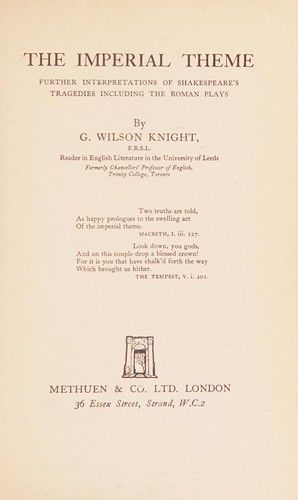
Imperial Theme: Further Interpretations of Shakespeare's Tragedies Including the Roman Plays
George Wilson Knight, G. Knight

Myriad-minded Shakespeare: essays on the tragedies, problem comedies, and Shakespeare the man
E.A.J. Honigmann.
Reader Reviews
No reviews yet for this book.
Be the first to share your thoughts!