
White Fragility
Why It's So Hard for White People to Talk About Racism
Our rough guess is there are 48,000 words in this book.
At a pace averaging 250 words per minute, this book will take 3 hours and 12 minutes to read. With a half hour per day, this will take 7 days to read.
How long will it take you?
This book will take an estimated to read at a reading speed averaging words per minute. With 30 minutes per day, this will take to read.
Enter your reading speedYou can take one of our WPM reading speed tests to find your reading speed.
Create a free account to track your reading progress, build your reading list, and set reading goals.
Author
Contributions
- Michael Eric Dyson - Foreword
Publication
2018 - Beacon Press, Boston, MA, USA
Language
English
Word Count
48,000 words, Guess
Page Count
192 pages
Physical Format
Electronic resource
Identifiers
- Open LibraryOL28029787M
- ISBN-139780807047422
- ISBN-100807047422
- OCLC Control Number1088664994
- Library of Congress Control Number2018003562
and 3 more
- AmazonB07638ZFN1
- Goodreads40141699
- GoogleZfQ3DwAAQBAJ
Classifications
- DDC305.8
- LCCHT1521 .D486 2018
Description
White people in North America live in a social environment that protects and insulates them from race-based stress. This insulated environment of racial protection builds white expectations for racial comfort while at the same time lowering the ability to tolerate racial stress. Although white racial insulation is somewhat mediated by social class (with poor and working class urban whites being generally less racially insulated than suburban or rural whites), the larger social environment insulates and protects whites as a group through institutions, cultural representations, media, school textbooks, movies, advertising, and dominant discourses. Racial stress results from an interruption to what is racially familiar. In turn, whites are often at a loss for how to respond in constructive ways., as we have not had to build the cognitive or affective skills or develop the stamina that that would allow for constructive engagement across racial divides. leading to what I refer to as White Fragility. White Fragility is a state in which even a minimum amount of racial stress becomes intolerable, triggering a range of defensive moves. These moves include the outward display of emotions such as anger, fear, and guilt, and behaviors such as argumentation, silence, and leaving the stress-inducing situation. These behaviors, in turn, function to reinstate white racial equilibrium. This book explicates the dynamics of White Fragility and how we might build our capacity in the on-going work towards racial justice. ([source][1]) [1]: https://robindiangelo.com/publications/
Excerpt
The United States was founded on the principle that all people are created equal.
Description
The New York Times best-selling book exploring the counterproductive reactions white people have when their assumptions about race are challenged, and how these reactions maintain racial inequality. In this “vital, necessary, and beautiful book” (Michael Eric Dyson), antiracist educator Robin DiAngelo deftly illuminates the phenomenon of white fragility and “allows us to understand racism as a practice not restricted to ‘bad people’ (Claudia Rankine). Referring to the defensive moves that white people make when challenged racially, white fragility is characterized by emotions such as anger, fear, and guilt, and by behaviors including argumentation and silence. These behaviors, in turn, function to reinstate white racial equilibrium and prevent any meaningful cross-racial dialogue. In this in-depth exploration, DiAngelo examines how white fragility develops, how it protects racial inequality, and what we can do to engage more constructively. source: https://www.penguinrandomhouse.com/books/566247/white-fragility-by-robin-diangelo/
Subjects
Topics
Places
People
Other Editions
- White Fragility: Why It's So Hard for White People to Talk About Racism
Similar Books
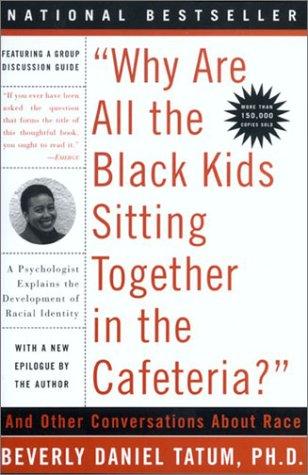
"Why are all the Black kids sitting together in the cafeteria?": and other conversations about race
Beverly Daniel Tatum.

Community-based ethnography: breaking traditional boundaries of research, teaching, and learning
Ernie Stringer ... [et al.].

White Rage: The Unspoken Truth of Our Racial Divide
Carol (Carol Elaine) Anderson

Between the World and Me
Ta-Nehisi Coates

Indigenous youth in Brazilian Amazonia: changing lived worlds
by Pirjo Kristiina Virtanen
Teaching about Race Relations: Problems and Effects
Lawrence Stenhouse, Jon Nixon, Robert Wild, Gajendra Verma
Breaking bread: insurgent Black intellectual life
by Bell Hooks and Cornel West.

White Trash: Race and Class in America
Annalee Newitz
Reader Reviews
No reviews yet for this book.
Be the first to share your thoughts!