
Real world research
a resource for users of social research methods in applied settings
3rd ed.
Our rough guess is there are 152,000 words in this book.
At a pace averaging 250 words per minute, this book will take 10 hours and 8 minutes to read. With a half hour per day, this will take 20 days to read.
How long will it take you?
This book will take an estimated to read at a reading speed averaging words per minute. With 30 minutes per day, this will take to read.
Enter your reading speedYou can take one of our WPM reading speed tests to find your reading speed.
Create a free account to track your reading progress, build your reading list, and set reading goals.
Author
Publication
2011 - Wiley-Blackwell, Chichester, West Sussex, England
Language
English
Word Count
152,000 words, Guess
Page Count
608 pages
Identifiers
- Internet Archiverealworldresearc0003robs
- ISBN-139781405182416
- ISBN-101405182415
- Library of Congress Control Number2010046378
- OCLC Control Number674941469
and 2 more
- Better World Books9781405182416
- Open LibraryOL25042436M
Classifications
- DDC300.72
- LCCH62 .R627 2011
- LCCH62.R627 2011
Description
"Given the positive nature of the review feedback, and following the basic 'if it ain't broke ...' principle, I propose to retain the same concept of a broadly-based text with an even-handed coverage of qualitative and quantitative approaches as in previous editions. There will be a continuing focus on what I have termed 'Real World Research' and an intention for it to serve as a resource for those planning to carry out a research project.I note that there were some critical comments on the design of the text, to which you will no doubt give due consideration. The index and glossary will of course be revisited.I aim to provide a greater amount of illustrative case study material, extensively updated examples from current research to illustrate recent developments, and updated annotated further reading sections in each chapter. I will be extending the coverage of:ʺ Ethics (perhaps the adopter who provided detailed suggestions in this area could be thanked and assured that the comments will be taken on board)ʺ On-line and internet researchʺ Evidence-based approaches, including systematic reviews and meta analysis (a not uncritical discussion of this currently 'hot' topic).I will also consider the other suggestions made by adopters (some of which are, as ever, mutually contradictory). I think it unlikely that I will include student exercises as I don't really see them as appropriate for the type of book that this is. I am also dubious about including more philosophical material (including epistemology and ontology) as it can easily alienate many students. However I will have a go at this and see what I can do. There is now a substantial literature on the realist approach in practice, some of which I will cover.I will also carry out a thorough re-evaluation of the multiplicity of qualitative and quantitative approaches to see which merit inclusion. Similarly with the analysis chapters - particularly the quantitative stuff.I do not propose to make firm decisions on SPSS or NVivo at this stage. Clearly any treatment would have to be in terms of the versions current near to publication. Versions are rapidly superseded and students get twitchy if the text they are using has an older version than the one on their computer. The alternatives are in-text coverage, appendices, associated websites, or reference out. The situation is complicated for me by the fact that I am no fan of SPSS because, although very widely used, it is not ideal for the type of exploratory quantitative approach that I favour.On appendices, I will give favourable consideration to the suggestion that the material in the appendix on writing a project proposal comes within the text itself. I am very likely to retain the second appendix in its present position.I will also be giving further thought to what might go into an associated website. I am somewhat attracted to the inclusion of discipline- or area-specific examples (eg health-related, education, applied psychology, etc) on the website - rather as I have in 'How to do a Research Project'. This helps get over the problem of alienating students with text examples outside their own discipline, or of stuffing the text itself with a very large number of examples from different disciplines. As discussed earlier, I will also consider including material for lecturers such as PowerPoint slides"-- "This bestselling text on carrying out research in 'real world' situations has been thoroughly revised and updated but continues to have the same authoritative voice and definitive content that has made it such an essential book for teachers and students conducting research within the social sciences"--
Subjects
Topics
Links
Similar Books

Qualitative inquiry and research design: choosing among five traditions
John W. Creswell.
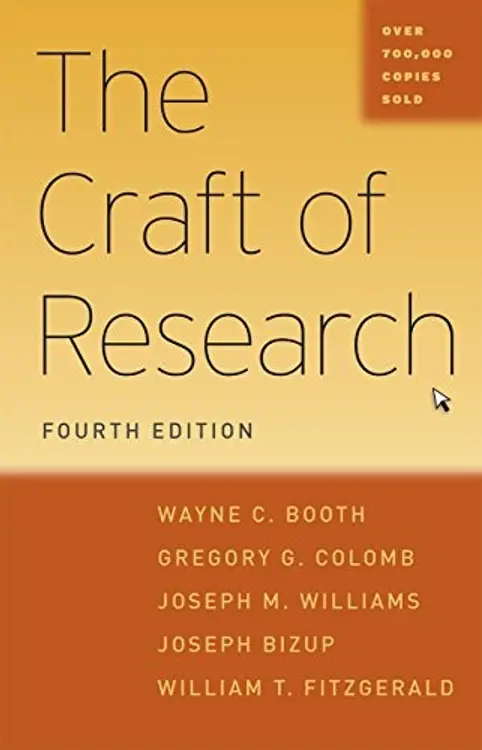
The craft of research
Wayne C. Booth, Gregory G. Colomb, Joseph M. Williams, Joseph Bizup, William T. FitzGerald

Meta-analytic procedures for social research
Robert Rosenthal.

Beginning behavioral research: a conceptual primer
Ralph L. Rosnow, Robert Rosenthal.

The practice of social research
Earl Babbie

Investigating the Social World
Russell K. Schutt

Dictionary of Statistics & Methodology: A Nontechnical Guide for the Social Sciences
W. Paul Vogt
Applying the Rasch Model: Fundamental Measurement in the Human Sciences
Zi Yan, Trevor Bond, Moritz Heene
Reader Reviews
No reviews yet for this book.
Be the first to share your thoughts!