
1812
Napoleon's Russian Campaign
Our rough guess is there are 131,250 words in this book.
At a pace averaging 250 words per minute, this book will take 8 hours and 45 minutes to read. With a half hour per day, this will take 18 days to read.
How long will it take you?
This book will take an estimated to read at a reading speed averaging words per minute. With 30 minutes per day, this will take to read.
Enter your reading speedYou can take one of our WPM reading speed tests to find your reading speed.
Create a free account to track your reading progress, build your reading list, and set reading goals.
Word Count
131,250 words, Guess
Page Count
525 pages
Physical Format
Hardback
Identifiers
- Open LibraryOL2206327M
- ISBN-139780471543022
- ISBN-100070527318
- OCLC Control Number20563997
- OCLC Control Numberisbn_9780070527317
and 3 more
- Library of Congress Control Number89028432
- Goodreads3388405
- LibraryThing576733
Classifications
- DDC940.2/7
- LCCDC235 .R43 1990
Description
A masterful and mildly revisionist assessment of Napoleon's disastrous attempt to make Russia a part of his empire. Drawing on archival sources newly translated from the French and German as well as standard references (including Clausewitz), military historian Riehn offers a richly detailed account of a great captain's comeuppance. Setting the stage with background on the martial arts in Europe during the early 19th century, as well as with big-picture perspectives on the continent's geopolitical alignments, he provides a coherent explanation of the objectives that induced Napoleon to invade Russia in mid-1812. At no small cost, the emperor marched his Grand Army across trackless wastes to Moscow, the motherland's spiritual hub, only to find it evacuated and ablaze. With his flanks vulnerable and forces depleted, Napoleon belatedly turned for home. He made it back to Paris, but most of his multinational legions perished on The Steppes. Napoleon himself attributed his defeat to ""General Winter,"" a verdict widely accepted by contemporaries and posterity. As Riehn makes clear, however, the bitter cold and snow came late that year, i.e., during the latter stages of the retreat. Miscalculations and errors, he argues, were the real causes of the campaign's failure. To begin with, Napoleon expected to win a set-piece battle early on and then negotiate an advantageous treaty with Tsar Alexander. Instead, he was obliged to tramp through backwaters that could not support his troops or horses in vain pursuit of a foe who would not stand and fight. Beset by logistical woes largely of his own making, moreover, Napoleon exhibited unwonted hesitancy in making command decisions at critical junctures. As a practical matter, Riehn concludes, the Corsican usurper was not prepared to sustain the kind of plodding offensive required to conquer Russia. While he did show flashes of his former brilliance, the calamitous outcome proved as inevitable as that of any classic tragedy where hubris plays a leading role. Military history of a very high order. The text has helpful maps, line drawings that illustrate tactical formations, a glossary, and a wealth of appendices enumerating the manpower of participating commands.
Subjects
Topics
Places
Other Editions
- 1812: Napoleon's Russian Campaign
Similar Books
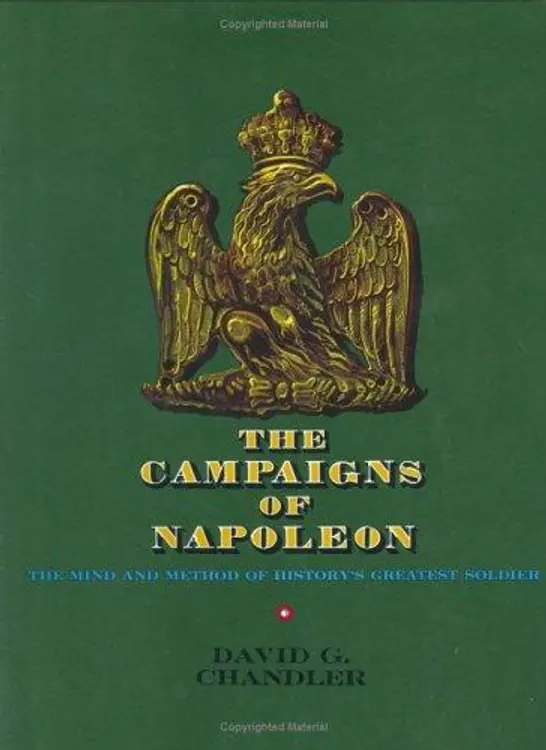
The Campaigns of Napoleon
David Chandler
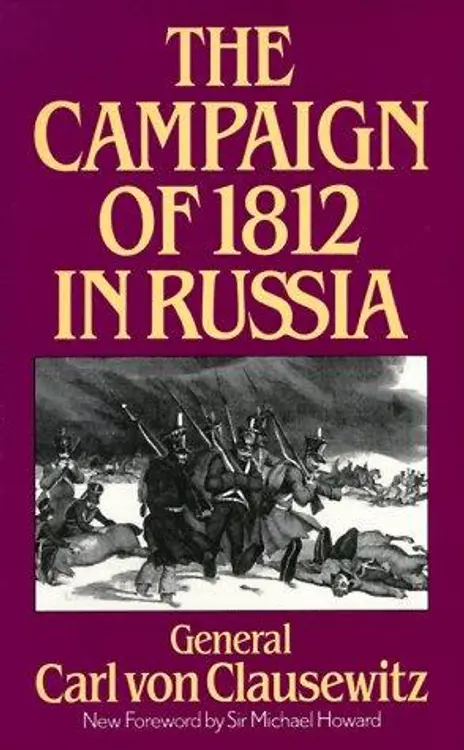
The campaign of 1812 in Russia
Carl von Clausewitz ; with a new foreword by Sir Michael Howard.

The Age of Napoleon: The Story of Civilization XI
by Will and Ariel Durant.

With eagles to glory: Napoleon and his German allies in the 1809 campaign
John H. Gill.

The First Total War: Napoleon's Europe and the Birth of Warfare as We Know It
David A. Bell
Austerlitz: Napoleon and the Eagles of Europe
Ian Castle

Napoleon: his wives and women
Christopher Hibbert.
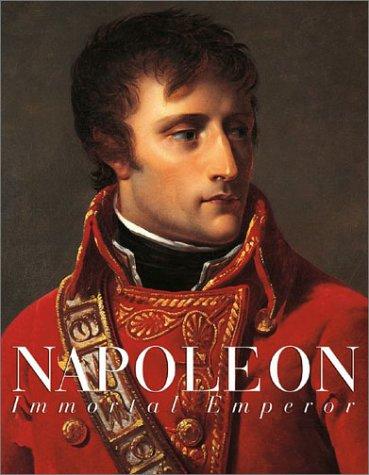
Napoleon: the immortal emperor
Gérard Gengembre ; in collaboration with Pierre Jean Chalenc̦on and David Chanteranne.
Reader Reviews
No reviews yet for this book.
Be the first to share your thoughts!